Executive Overview: Solving the Surface Contamination & Flaking Crisis in Collision Repair
In modern automotive collision repair and production paint facilities, masking efficiency and overspray containment directly dictate cycle times, labor costs, and overall refinish quality. For decades, body shops struggled with conventional low-density polyethylene (LDPE) plastic films and standard masking papers. Traditional films frequently suffered from low surface tension, causing dry basecoats and clearcoats to flake off during paint booth airflow cycles—landing back into wet paint and requiring costly color sanding, buffing, or complete panel re-sprays.
KeyKling Plastic Sheeting, manufactured under the premium Platinum Refinish product line and distributed across North America by Auto Parts Outlet (APO), represents a technological breakthrough in surface protection science. Designed specifically to solve the complex physics of paint overspray adhesion, KeyKling incorporates state-of-the-art inline corona discharge treatment, engineered electrostatic static attraction, and high-tensile multi-layer polyolefin film extrusion.
Procurement Executive Summary: The Information Gain Advantage
Global procurement managers, body shop network directors, and refinish facility engineers evaluating surface masking systems must look beyond base price per roll. KeyKling Plastic Sheeting provides tangible operational ROI by reducing masking labor hours by up to 35%, eliminating paint flaking contamination, withstanding bake booth temperatures up to 230°F (110°C), and securing volume pricing through APO’s nationwide logistics network.
The Science of Paint Overspray Adhesion (Corona Discharge Physics)
The primary failure mechanism of cheap import masking film is poor surface wetting energy. Standard polyethylene possesses a non-polar surface energy of approximately 30 to 32 dynes/cm. Solvent-borne paints and modern waterborne basecoats (such as Wanda Refinish systems) possess significantly higher surface tension. When overspray contacts untreated film, it forms spherical droplets rather than a continuous film. Once dry, these droplets lack chemical or mechanical anchorage, flaking off when the technician moves the masking film or when booth fans flex the sheet.
KeyKling Plastic Sheeting undergoes intense high-frequency molecular corona treatment during fabrication. This process bombards the film surface with high-voltage electrical fields, creating oxygenated polar functional groups (carbonyl, hydroxyl, and carboxyl species) on the polyolefin chain. This raises KeyKling's surface energy to a certified 44 to 48 dynes/cm.
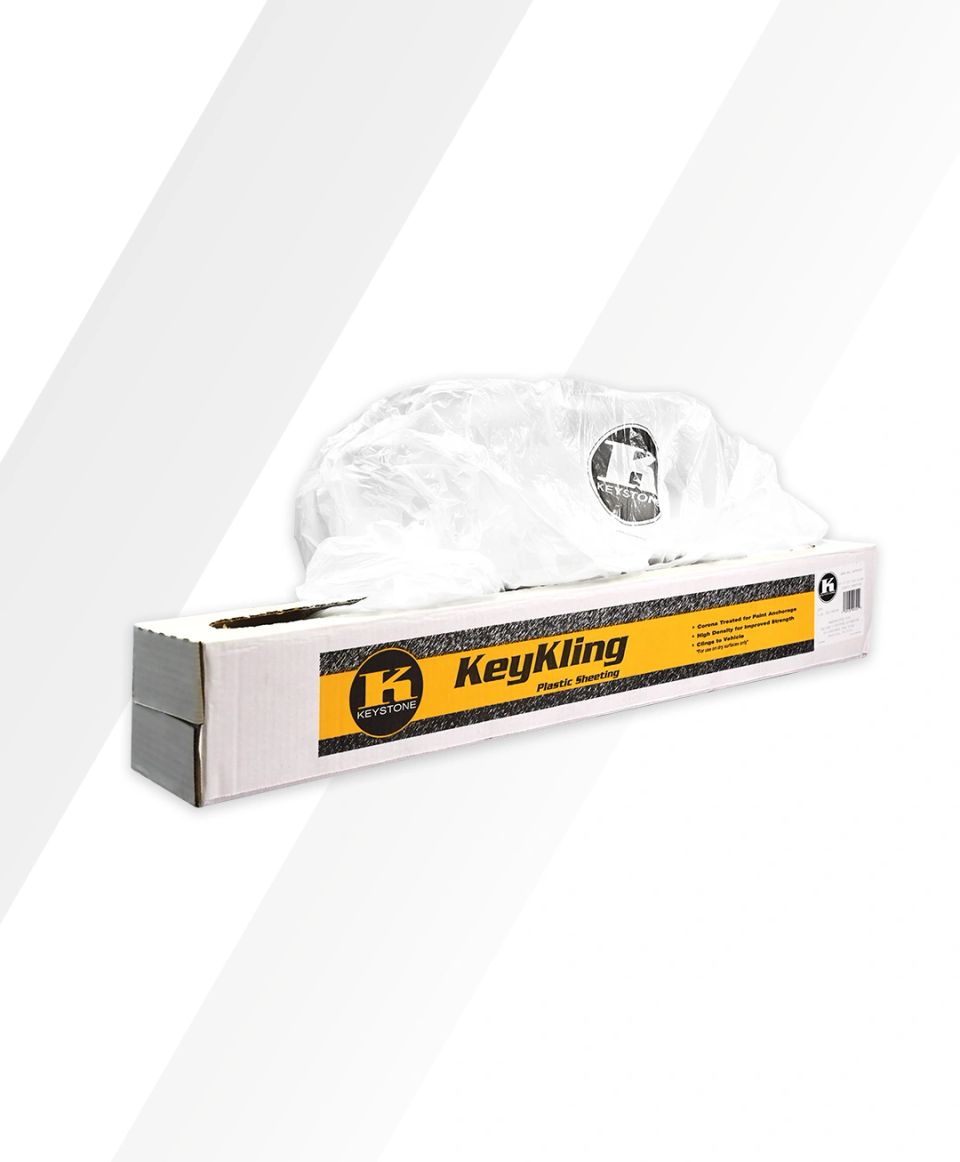
As a direct result of this 48 Dyne corona treatment, atomized paint droplets instantly spread, wet out, and mechanically lock into the molecular lattice of the film. Whether spraying high-solids polyurethane clearcoats, waterborne primers, or solvent basecoats, overspray dries as a flexible, bound layer that will not flake off—even when the film is folded, crinkled, or subjected to 120 km/h spray booth downdraft velocity.
