A close paint match is more than a code on a label. It must hold up under the room’s lighting, across different surfaces, and after the paint dries. This guide to the Top 10 Custom Color Match Paint Suppliers Worldwide compares the practical details buyers often need: color-matching methods, available finishes, order sizes, sample options, and support for repeat orders.
Color specialist Leatrice Eiseman offers a useful perspective on color perception. The following is an editorial paraphrase, not a direct quotation: “A color match must be judged in its setting, not by the chip alone.” That distinction matters. A small swatch under a shop’s cool LED lights may look different beside a sunlit wall at home. Even a carefully matched sample can shift on textured wood or patched drywall.
The suppliers featured here serve different needs. Some focus on quick retail matching; others support larger projects and custom formulations. We consider how clearly each explains its process, what information it requests, and whether customers can test a sample before committing. A paint photo can help, but it cannot fully capture sheen, surface texture, or changing daylight. A little inconvenient, perhaps. Still, a fair comparison should name those limits rather than promise a perfect match. This overview is a starting point, not a substitute for testing the paint on the actual surface.
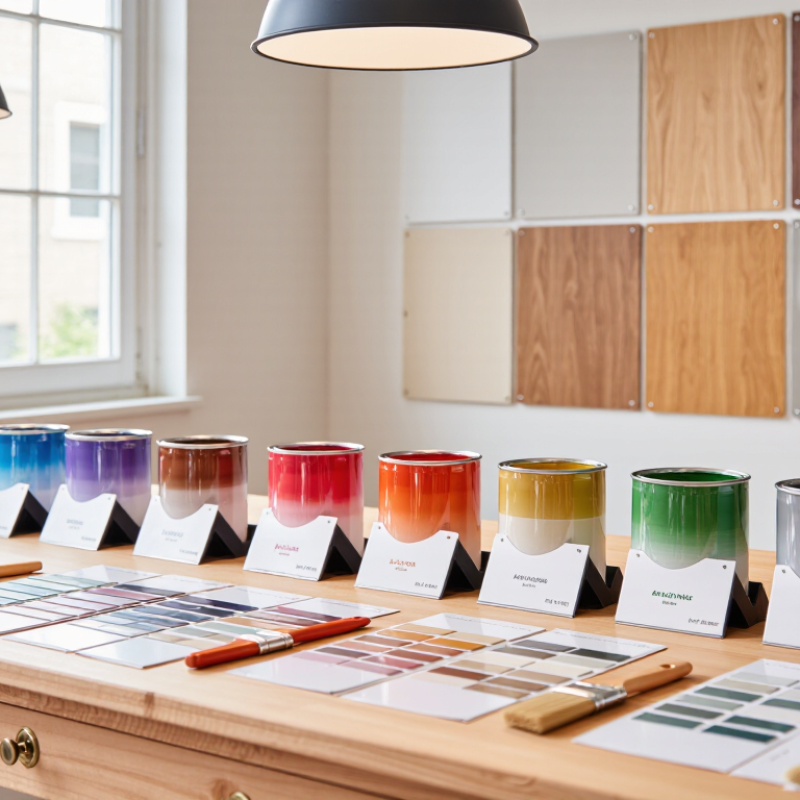
Define Custom Color Matching Across Industrial, Architectural, and Automotive Paints
Custom color matching means translating a sample into a repeatable paint formulation, not simply choosing a similar shade from a chart. A spectrophotometer measures reflected light, while technicians adjust pigments and test drawdowns on the intended substrate. A target is not just a code. ASTM D2244 provides methods for calculating color differences, but acceptable tolerances still depend on the application and viewing conditions.
Industrial coatings must retain color across batches and withstand heat, chemicals, or abrasion. Architectural paints also respond to surface texture, sheen, daylight, and room lighting. Automotive finishes add metallic or pearlescent effects, where particle orientation can change the appearance across a curved panel. Light changes everything. A match under a booth lamp may look wrong outdoors, so visual checks under controlled lighting remain important.
The Grand View Research paints and coatings market report estimated the global market at USD 202.8 billion in 2023. That scale helps explain why consistent color matters across varied uses, though market size does not prove any supplier’s matching accuracy. In practice, reliable specifications record the substrate, gloss, film thickness, lighting, and curing conditions alongside the color target. A perfect digital reading can still disappoint on a textured wall. That is not enough. Recheck the physical sample before approving production.
Top 10 Custom Color Match Paint Suppliers Worldwide? — Defining Custom Color Matching Across Industrial, Architectural, and Automotive Paints
A practical comparison of ten supplier capability areas—not a ranked list of named companies. Requirements vary by specification, substrate, application method, and approval process; color tolerances should be agreed between buyer and supplier.
| No. | Supplier capability or evaluation dimension | Industrial paints | Architectural paints | Automotive paints |
|---|---|---|---|---|
| 1 | Color target definition | Targets may be supplied as a physical sample, a color standard, or specified CIELAB values. The target should be measured under agreed conditions. | Targets commonly include physical samples or documented color references; appearance should be checked on the intended wall or finish where practical. | Targets often include an approved vehicle panel or a defined original-equipment color reference; visual approval is important for production matching. |
| 2 | Instrumental color measurement | Suppliers may use spectrophotometers with 45°/0° or diffuse/8° geometry; the geometry and specular setting should be consistent across comparisons. | Instrument readings help control batch consistency, but texture, sheen, and application can affect perceived color. | Multi-angle spectrophotometers are used for many metallic and pearlescent finishes because appearance changes with viewing angle. |
| 3 | Color-difference reporting | CIELAB-based color differences, such as ΔE*ab or ΔE00, can be used. Acceptance limits are project-specific, not universal. | Color differences can be reported instrumentally, with visual review recommended for large surfaces and different lighting conditions. | Color-difference results should be interpreted alongside angle-dependent measurements and visual comparison on a properly prepared panel. |
| 4 | Special-effect color capability | Capability may include metallic, pearlescent, fluorescent, or other effect pigments when permitted by the product specification. | Most standard architectural colors are solid colors; metallic or special-effect finishes are available in some product systems. | Metallic, pearlescent, and other effect finishes require control of pigment orientation, film build, and application conditions. |
| 5 | Substrate and sample preparation | Matching should use the specified substrate and coating build because primer, substrate color, and film thickness can change the result. | Porosity, primer, texture, and the number of coats can influence the final appearance; test patches should follow the intended application method. | Panel preparation, undercoat shade, basecoat application, and clearcoat can all affect the finished color and appearance. |
| 6 | Application-process control | Spray, dip, roll, or powder application may produce different appearances; the approved method and curing conditions should be documented. | Brush, roller, and spray application can differ in texture and apparent color, so sample application should represent site practice. | Spray technique, flash time, film thickness, and drying or curing conditions are critical, especially for effect finishes. |
| 7 | Gloss and surface appearance | Gloss can be measured using methods such as ASTM D523 or ISO 2813 at the applicable measurement geometry. | Sheen and surface texture affect perceived color; specify the intended finish and evaluate a representative dried sample. | Gloss, metallic flop, texture, and clearcoat appearance are assessed together; color matching alone does not define the full finish. |
| 8 | Durability and exposure testing | Testing depends on exposure and service conditions and may include corrosion, chemical resistance, or accelerated weathering evaluations. | Exterior products are commonly evaluated for weathering and color retention using the relevant product or project requirements. | Coatings may require weathering, environmental, and other vehicle-specific performance tests in addition to color approval. |
| 9 | Standards and specification handling | Industrial projects may reference standards such as ISO 12944 for corrosion-protection systems; the specified system and test conditions matter. | Requirements vary by building type, location, and product specification; standards and test methods should be identified in the project documents. | Automotive requirements are often defined by the vehicle maker or project specification; the applicable test procedures and acceptance criteria must be confirmed. |
| 10 | Documentation and repeatability | Useful records include the approved target, formula or batch reference, substrate, application conditions, and test results. | Batch identification, finish, application guidance, and retained reference samples help manage touch-ups and later production. | Documented panel approvals, measurement conditions, process settings, and batch traceability support repeatable production matching. |
FAQS
Place a clean reference panel beside the cured sample. Use consistent lighting and viewing angles. Small shade shifts can stand out across a large surface.
Record the lighting, substrate, coating thickness, and curing conditions. These details help explain differences between samples and make repeat checks more useful.
No. Observers may disagree, even under controlled conditions. Still, judgment varies.
Use a specified tape-test procedure suited to the coating and setup. Prepare the surface consistently, let the coating cure, and document the method and rating.
No. A clean cut or tape pull cannot predict performance in every environment. Ask for the test conditions and results, not just a pass claim.
Request samples from separate batches, not repeated readings from one tin. Ask for written tolerance details, including the measurement method, substrate, and lighting.
It should cover color approval, material sourcing, production, and dispatch. Confirm how approval delays or batches outside tolerance affect the schedule.
Compare the minimum order with expected coverage, test panels, and touch-ups. Check package sizes too; leftover paint can become waste. A little awkward, but worth checking.
Include color, finish, batch tolerance, lead time, and minimum order quantity. Also ask whether a reference sample is retained for repeat orders, and for how long.
Conclusion
Custom Color Match Paint enables manufacturers and property owners to reproduce a target shade across industrial, architectural, and automotive applications. A reliable comparison begins with how suppliers measure color difference using CIELAB ΔE00 and ASTM D2244, then confirms the result through visual assessment under controlled conditions. Adhesion testing, including methods such as ASTM D3359, can help determine whether a matched coating performs as expected on its intended surface.
When evaluating ten suppliers worldwide, consider more than color-matching technology. Compare their technical support, service capabilities, and market reach, along with practical measures of consistency: batch-to-batch tolerances, typical lead times, and minimum order quantities. Reviewing these factors together offers a balanced way to identify a supplier suited to a project’s color requirements, performance needs, and production schedule.